The benefits of ITIL 4 come down to one outcome: technology services that reliably create value for the business and its customers. ITIL 4 helps organizations align IT with business goals, raise service quality, reduce disruptions, manage risk, control costs, and improve continually, all while working alongside Agile and DevOps. That makes it a practical backbone for digital transformation.
Investment in transformation keeps rising. The International Data Corporation (IDC) Worldwide Digital Transformation Spending Guide, released in May 2024, forecasts that worldwide digital transformation spending will reach almost $4 trillion in 2027, growing at a 16.2% compound annual rate over 2022 to 2027 (IDC spending forecast). As more products and services run on technology, the way those services are managed decides whether that spending pays off. This guide, updated for 2026, explains what ITIL 4 is, the 10 benefits it delivers, and how to start realizing them.
What Is ITIL 4?
ITIL 4 is the 2019 edition of ITIL (originally short for Information Technology Infrastructure Library), the widely adopted best-practice guidance for IT service management (ITSM). AXELOS published ITIL 4 in February 2019, and PeopleCert, which acquired AXELOS in 2021, now owns, publishes, and examines the framework.
Where earlier versions centered on processes, the ITIL 4 framework is built around the service value system (SVS): guiding principles, governance, the service value chain, management practices, and continual improvement, all working together to turn demand into value. It also asks organizations to consider four dimensions of service management: organizations and people; information and technology; partners and suppliers; and value streams and processes.
A note for 2026 readers: PeopleCert launched ITIL (Version 5) in February 2026 and currently plans to sunset all ITIL 4 modules on December 31, 2027, according to its ITIL FAQ. ITIL 4 qualifications remain recognized as prerequisites for higher-level ITIL (Version 5) certifications, so the concepts and benefits below still apply. Professionals applying for service management roles during this transition may also want to review ITIL V5 interview questions so they can discuss both versions with confidence.
Why Does ITIL 4 Matter for Digital Transformation?
ITIL 4 matters because digital transformation turns IT from a support function into the way the business creates value. The framework gives teams a shared model for planning, building, delivering, and improving technology-enabled services, so new digital products launch with clear ownership, controlled change, and measurable outcomes instead of ad hoc fixes.
In practice, organizations use ITIL 4 to identify what customers need, plan services around that demand, and deliver them cost-effectively. It helps manage the risks and disruptions that come with constant change, and it keeps service teams focused on customer satisfaction and business performance rather than technology for its own sake.
At the heart of the framework is value co-creation: value is not something IT hands over, but something the provider and the consumer create together through every interaction.
The seven ITIL guiding principles turn that idea into everyday decisions: focus on value; start where you are; progress iteratively with feedback; collaborate and promote visibility; think and work holistically; keep it simple and practical; and optimize and automate.
What Business Advantages Does ITIL 4 Deliver?
ITIL 4 delivers ten core advantages, ordered here by their impact on transformation outcomes: closer IT and business alignment, higher service quality, fewer disruptions, stronger risk control, compatibility with Agile and DevOps, cost visibility, measurable continual improvement, a holistic four-dimension view, a shared global language, and career value for the people who apply it.
1. Closer Alignment Between IT and Business
ITIL 4 starts from value, not technology. The focus on value principle and the service value chain tie every IT activity to an outcome the business or its customers care about, and they improve communication and collaboration between business and IT teams. When IT problems are framed as business problems, technology becomes part of the business environment rather than a separate cost center.
Organizations that formalize this alignment usually capture it in an ITSM strategy that links service goals to business objectives.
2. Higher Service Quality and Customer Satisfaction
High-quality services keep IT operations smooth and meet customer expectations consistently. ITIL 4 practices such as service level management and service desk set clear targets and give customers a reliable point of contact. Satisfied customers stay longer, and in crowded digital markets that retention is a genuine competitive edge.
3. Fewer Service Disruptions
Outages and failed changes happen in every IT organization, but ITIL 4 reduces how often they occur and how long they last. Incident management restores service quickly, problem management removes underlying causes, and change enablement makes sure changes are assessed and authorized before they reach live services.
Change control is often the quickest win: a structured rollout of ITIL change management aims to reduce failed changes while keeping delivery moving.
4. Stronger Risk Management
Every project and service carries risk. ITIL 4 builds risk thinking into governance and into practices such as risk management, information security management, and service continuity management, so threats are identified early and mitigations are ready if a risk materializes. Close alignment between IT and the business also means technical glitches are fixed before they turn into business consequences.
5. Works With Agile, DevOps, and Lean
ITIL 4 was designed to sit alongside other ways of working. Its guidance draws on Agile, DevOps, and Lean thinking, and principles such as progress iteratively with feedback mirror Agile delivery, so teams do not have to choose between speed and control. The result is easier collaboration across development and operations teams.
The specific gains from pairing ITIL and Agile are covered in a dedicated guide.
6. Clearer Visibility and Control of IT Costs
ITIL 4 makes the cost of each product and service visible, which helps leaders cut unnecessary spend and make confident cost decisions. The service financial management practice connects spending to the value each service creates, so budgets follow business priorities rather than habit.
7. Continual Improvement Driven by Measurement
In ITIL 4, continual improvement is a core component of the service value system, not an afterthought. Its improvement model asks teams to confirm the vision, measure where they are now, define where they want to be, plan how to get there, act, check whether they got there, and keep the momentum going.
Regular monitoring feeds that cycle. Live service data and past performance trends show where delivery is slipping and which improvements will matter most to customers.
8. A Holistic View Through the Four Dimensions
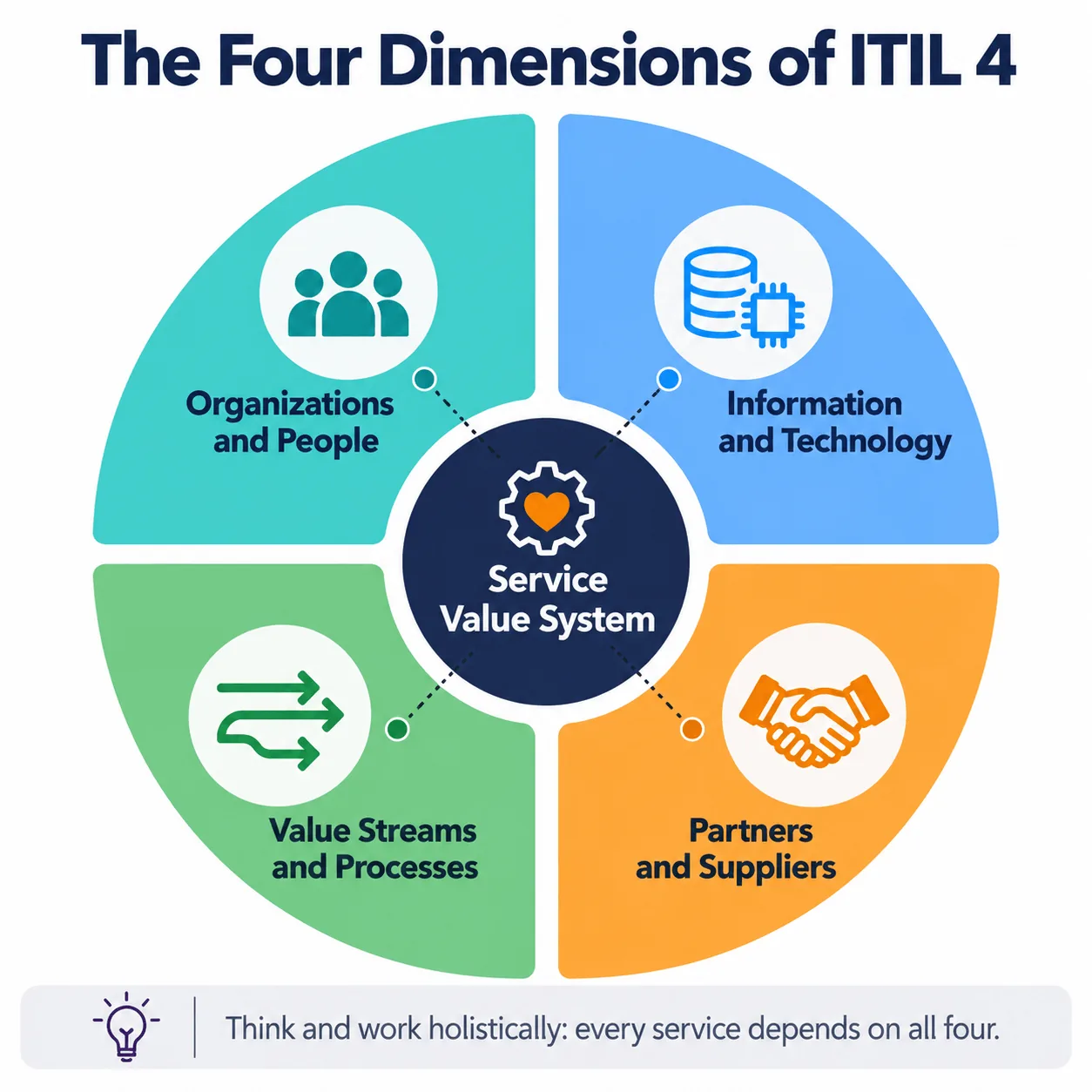
A new tool on its own does not transform a service. The four dimensions of service management push teams to plan every change across organizations and people, information and technology, partners and suppliers, and value streams and processes. Reviewing initiatives against all four reduces blind spots, such as a platform upgrade that ignores supplier contracts or staff skills.
9. A Shared Language and Global Community
Because ITIL is used worldwide, it gives IT teams, suppliers, and business stakeholders a common vocabulary for services, incidents, changes, and value. That shared language makes partner work smoother and connects practitioners to a large global community where common problems and proven solutions are discussed openly. ITIL 4 also complements formal standards such as ISO/IEC 20000 for service management. Understanding how ITIL and ISO/IEC 20000 differ helps organizations decide whether they need flexible guidance, an auditable standard, or a combination of both.
10. Career Value for IT Professionals
The benefits extend to individuals. ITIL 4 certification gives professionals a recognized foundation in service management that applies across industries and roles, from service desk analysts to IT managers. PeopleCert states that ITIL 4 qualifications are recognized as prerequisites for higher-level ITIL (Version 5) certifications, so credentials earned now continue to count. Mapping out an ITIL certification career path early helps professionals choose the modules that best match the roles they want to grow into.
ITIL 4 Benefits at a Glance
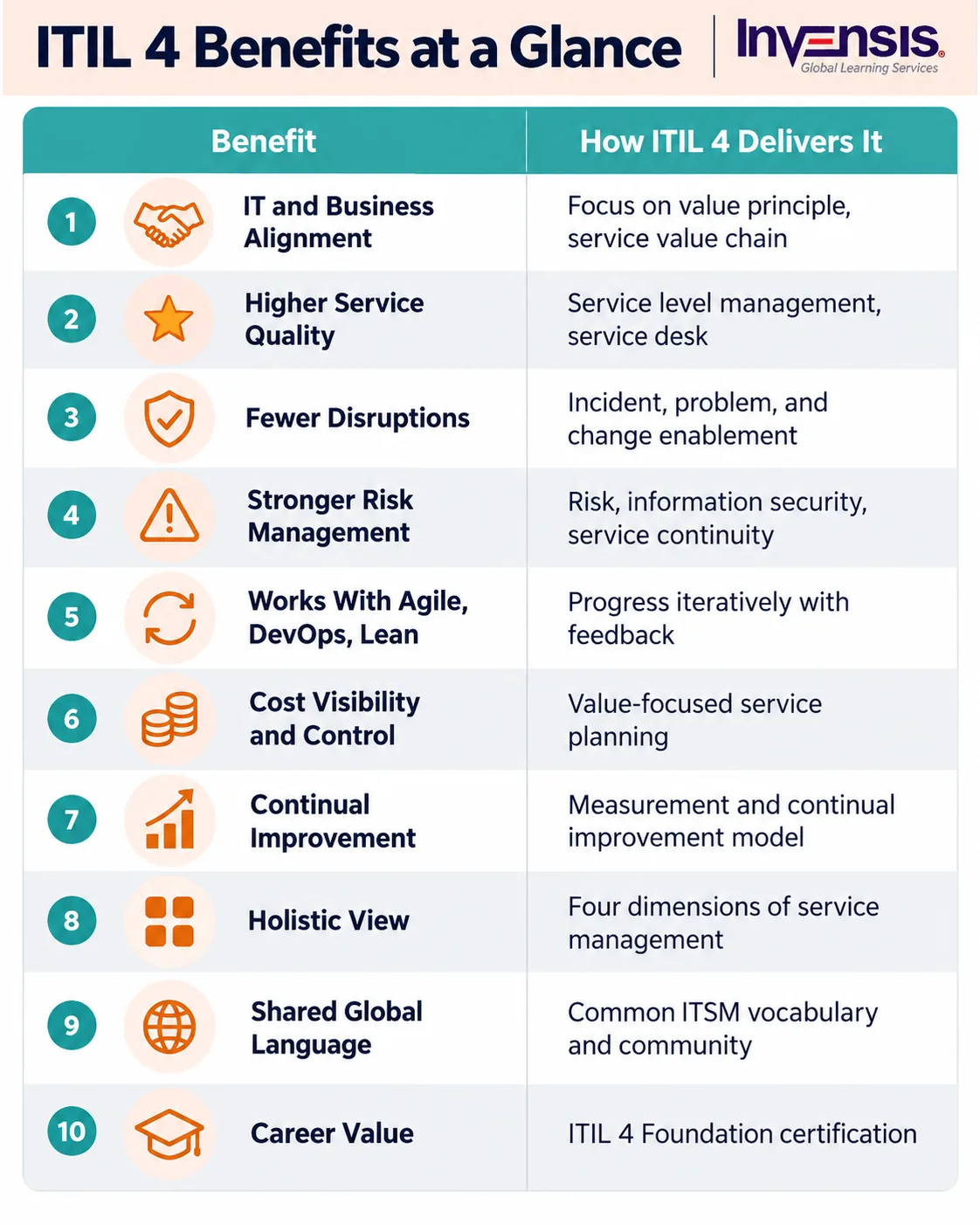
The table below maps each benefit to what changes in the organization and the ITIL 4 element that drives it.
| Benefit | What Changes for the Organization | ITIL 4 Element Behind It |
|---|---|---|
| IT and business alignment | IT work is tied to business outcomes | Focus on value principle; service value chain |
| Service quality | Clear targets and a reliable point of contact | Service level management; service desk |
| Fewer disruptions | Faster recovery and fewer repeat failures | Incident management; problem management; change enablement |
| Risk management | Threats identified early, mitigations ready | Governance; risk management; service continuity management |
| Agile and DevOps fit | Speed without losing control | Progress iteratively with feedback principle |
| Cost visibility | Spend linked to the value of each service | Service financial management |
| Continual improvement | Improvement becomes routine, not reactive | Continual improvement model |
| Holistic view | Fewer blind spots in transformation projects | Four dimensions of service management |
| Shared language | Smoother work with partners and suppliers | Common ITIL terminology; global community |
| Career value | Recognized, transferable skills | ITIL 4 qualification scheme |
How Can Organizations Start Realizing These Benefits?
Organizations realize the value of ITIL 4 fastest by starting small: assess current services, choose the practices that address the biggest pain points, train the people who will run them, and improve in short cycles. The steps below follow the start where you are and progress iteratively with feedback principles. Trying to adopt every practice at once, or treating the framework as a rigid rulebook, are among the ITIL implementation mistakes that this approach helps avoid.
- Assess where you are. Map existing services, pain points, and metrics before changing anything.
- Prioritize a few practices. Pick the two or three practices, such as incident management, change enablement, or service level management, that fix the most visible problems.
- Build skills. Train the people who will run the practices. The ITIL 4 Foundation exam has 40 multiple-choice questions, lasts 60 minutes, is closed book, and requires 65% to pass, with no formal prerequisites, according to PeopleCert exam details.
- Prepare with a plan. A structured study approach, like these tips for the ITIL 4 exam, shortens preparation time.
- Measure and improve. Track the agreed metrics and feed the results into the next improvement cycle.
For guided, instructor-led preparation, an accredited ITIL 4 Foundation course covers the service value system, the guiding principles, and the practices tested in the exam. The benefits of ITIL 4 Foundation certification extend beyond the exam itself, since certified staff can apply the guiding principles directly to everyday service decisions.
Conclusion
The benefits of ITIL 4 go well beyond tidier IT processes. The framework aligns technology with business value, raises service quality, reduces disruption and risk, makes costs visible, and builds a habit of continual improvement that keeps digital transformation on track. Even with ITIL (Version 5) now available, ITIL 4 remains a recognized and practical foundation through its planned sunset at the end of 2027.
The quickest path from theory to results is a focused, phased ITIL implementation backed by trained people. Invensis Learning offers ITSM training to help teams build those skills and put the framework to work.
Frequently Asked Questions
Is ITIL 4 still worth learning in 2026?
Yes. PeopleCert launched ITIL (Version 5) in February 2026, but it currently plans to keep ITIL 4 modules available until December 31, 2027, and ITIL 4 qualifications are recognized as prerequisites for higher-level ITIL (Version 5) certifications. The core ideas of value, practices, and continual improvement carry forward.
What is the difference between ITIL and ITSM?
IT service management (ITSM) is the discipline of designing, delivering, and improving IT services. ITIL is a framework of best-practice guidance for doing ITSM. An organization can practice ITSM without ITIL, but ITIL gives it a proven, widely used structure and vocabulary.
How is ITIL 4 different from ITIL v3?
ITIL v3 organized its guidance around a five-stage service lifecycle and 26 processes. ITIL 4 replaces that structure with the service value system and 34 management practices, adds the seven guiding principles and the four dimensions of service management, and is designed to work alongside Agile, DevOps, and Lean.
Can small businesses use ITIL 4?
Yes. ITIL 4 is flexible guidance, not a rigid standard, so small teams can adopt only the practices they need, such as incident management and service desk, and expand later. The keep it simple and practical principle explicitly discourages unnecessary process.
How soon do organizations see results from ITIL 4?
There is no fixed timeline; results depend on scope, current maturity, and how many practices are adopted at once. Teams that start with one or two high-impact practices and improve in short cycles can see measurable changes, such as faster incident resolution, sooner than with a large, all-at-once rollout.
Who should take the ITIL 4 Foundation certification?
Anyone who works in or alongside IT service delivery, including service desk staff, IT operations teams, developers, project managers, and IT leaders. PeopleCert sets no formal prerequisites for ITIL 4 Foundation, which makes it a common first step into service management. If you are preparing for a role in this area, practicing answers to common ITSM interview questions is a good way to test how well you can explain these concepts.